 CapaOne
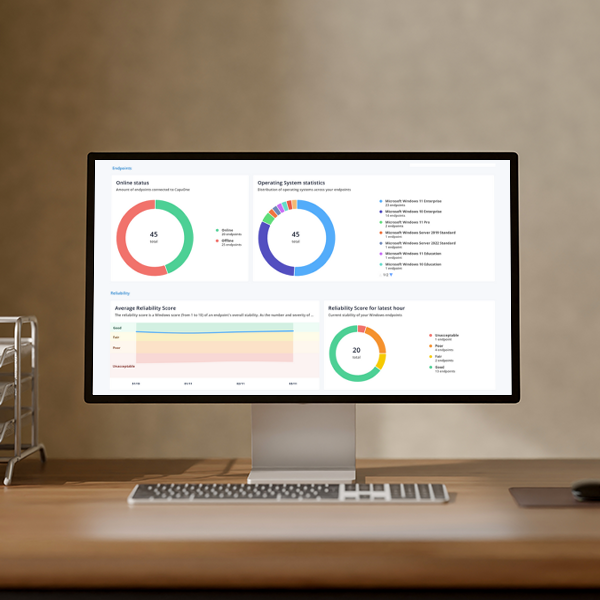

CapaOne delivers a unified view of your entire endpoint attack surface, pinpointing hidden vulnerabilities and risks across operating systems, applications, drivers, and configurations to show exactly how exposure propagates across your fleet.
CapaOne is built to solve exactly these points-without replacing Intune.
Vulnerabilities and risks, caused by outdated versions and configuration issues, surface across multiple disparate tools – making endpoint exposure assessment difficult.
Teams switch between consoles to understand which endpoints are exposed and why, delaying meaningful action.
One tool scans, another updates, a third reports — with spreadsheets filling the gaps.
Outdated applications and stale drivers extend exposure windows and requires ongoing manual effort.
Missing or weakened security settings create inconsistencies across the fleet, broadening the attack surface and complicating compliance audits.
Demonstrating reduced exposure for NIS2/GDPR is hard without unified evidence.
Scope, severity and impact indicators convert to an overall risk score, clearly showing what to fix first.
Cross-layer context across operating systems/drivers/applications/ configurations pinpoints software age, misconfigurations and known CVEs.
Cohort grouping by hardware model, operating system, filters, and tags drives maximum risk reduction with minimum effort.
Application Manager keeps third-party and business applications current, eliminating the risk tied to outdated software.
Driver Manager deploys vendor-supported driver versions, mitigating the security risks posed by legacy or inconsistent drivers.
Security Monitor surfaces misconfigurations and drift so protections can be restored before issues escalate.
CSV exports and shareable dashboards provide auditors, leadership, and security teams clear evidence of vulnerabilities, affected endpoints, and posture gaps.
CSV-based reporting supports tracking, incident reduction and the effect of operational changes.
EU-hosted platform supports GDPR and NIS2-ready operations and digital sovereignty requirements.
No. CapaOne provides vulnerability insights and exposure context – it’s created to complement Microsoft Intune.
Security Monitor uses CVE-based signals combined with configuration and version posture to pinpoint and present exposed endpoints.
Vulnerabilities are remediated by leveraging Application and Driver Manager to deploy the latest applications and drivers via automated workflows.
CSV exports and shareable dashboards, and API feeds make it easy to share vulnerability and posture data during audits or internal reviews.
Yes — vulnerabilities can be viewed by severity, impact, and scope to help teams focus where it matters most.
CapaOne is a European-built cloud-native Endpoint Management Platform that completes Microsoft Intune, giving IT teams an automation-first way to simplify operations, strengthen security, eliminate tool sprawl, and deliver hassle-free IT at scale.

Copyright © All Rights & Reserved 2026 CapaOne


