



Privilege Manager

Just-in-time local admin—secure elevation without slowing anyone down

ration
CapaOne-Privilege-Symbol
CapaOne-Privilege-Monitor
CapaOne Mobile Manager

What You Can Do

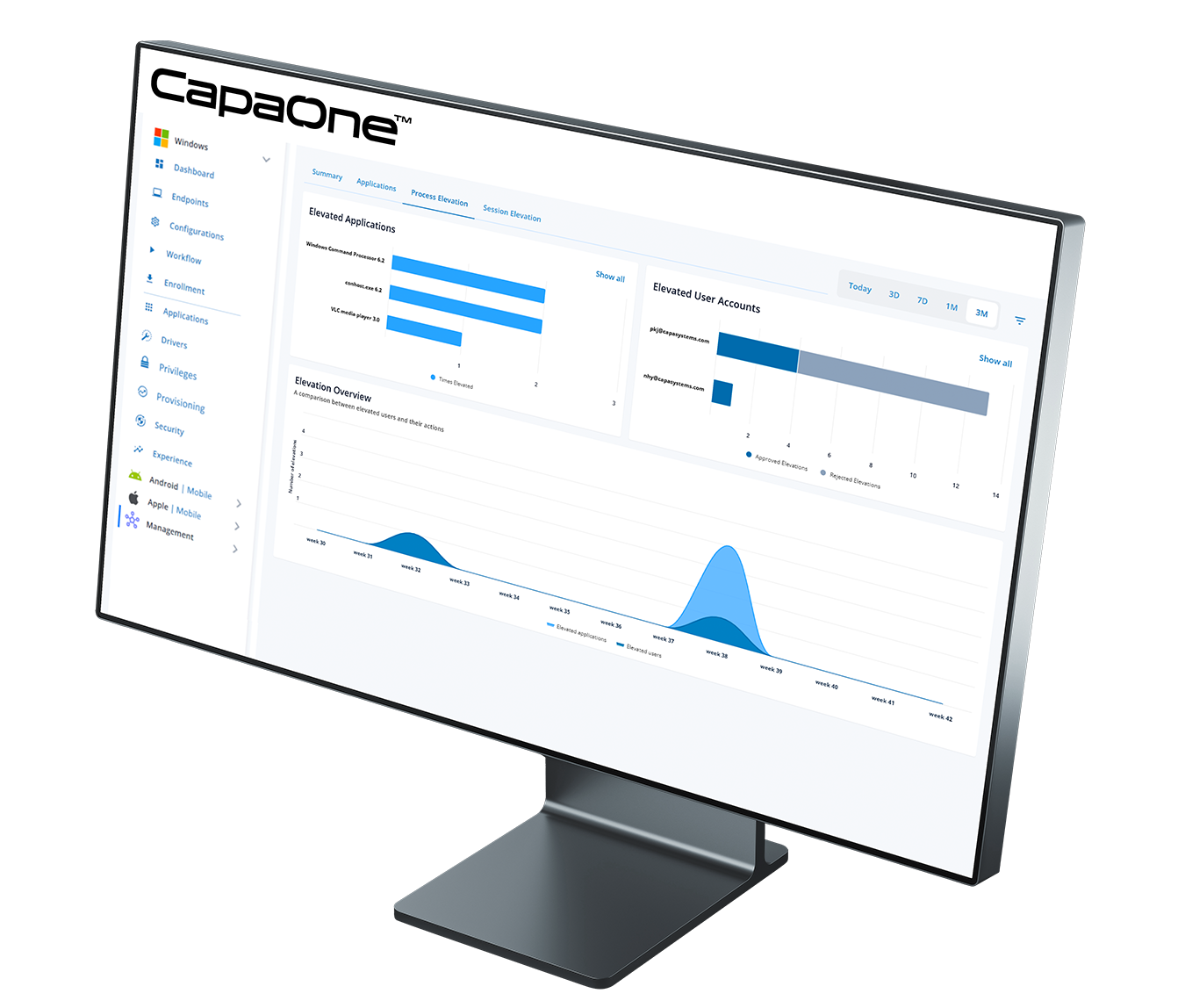
Privilege Manager removes standing local admin rights and replaces them with time-bound, auditable elevation. Users request (or receive) privileges only when needed, for the exact task or application, and only for a defined window of time—so work keeps moving while risk stays low. It integrates cleanly with your Intune setup and supports the principle of least privilege.

Key Capabilities

Time-Bound Elevation

Grant admin privileges for minutes, not days—auto-revoke on expiry.

Scope-by-Design

Elevate a specific executable, installer, command, or task—not the entire session.

Session Elevation

Quiet, in-context prompts with configurable notifications and minimal disruption.

Policy Engine

Define who can elevate what, where, and under which constraints.

Guardrails

Fully customizable controls for high-risk tools and sensitive actions.

Break-Glass Controls

Tightly scoped emergency elevation for critical, time-sensitive situations.

Logs & Evidence

Who/what/when, endpoint, changes, outcome status; export CSV for audits.

User Experience Controls

Define who can elevate what, where, and under which constraints.

1-Minute Product Walkthough

How It Fits with Intune

Security & Compliance

Operational Benefits

Goals You Can Achieve

Typical Rollout Pattern

1

Baseline & Remove standing local admin from target groups.

2

Define Policiesfor standard tasks (e.g., approved installers, printers, VPN clients).

3

Pilot with short duration and strict guardrails; review logs and tweak policies.

4

Operationalize with reports, scheduled reviews of policies, and periodic access recertification.

Have More Questions?

Users trigger elevation for a specific executable. Policies decide whether to auto-approve or deny. Admin privileges apply only to that scope and auto-expire.

Yes. Create deny rules for shells or unsigned installers and require explicit policy exceptions for controlled use.

Best practice is no standing admin. Use policies for routine tasks and break-glass elevation for rare exceptions.

User, endpoint, binary details (executable name, app path), time, duration, and outcome—all exportable.

Set short duration auto-revoke.

Yes. Target policies via Entra ID groups, respect existing group structure, and run alongside your Intune compliance and configuration.

Policies can allow cached decisions for low-risk tasks with strict durations, and queue logs for sync when the endpoint is back online.

Yes. Supporters can authorize a scoped, time-bound elevation without exposing local admin accounts.

Typically within minutes as it’s a very simple configuration, executed in a phased approach: remove standing local admin privileges, apply standard policies to test endpoints, then scale to departments with measured guardrails and reporting.

Latest from Us

Patch Management: Stop Outdated Software Before It Stops You

More than half of organizations run endpoints on outdated software. The problem is not awareness — it is the absence of automated, consistent patch management across applications, drivers, and mobile devices.  A recent security report found that more than half of organizations worldwide run devices with outdated operating systems. 95 percent of analyzed applications contain at […]

Rikke Borup
No comments

When security is no longer optional — join us at the CapaSystems User Group

The threat landscape has changed. Has your endpoint strategy kept up? The threat landscape is shifting faster than ever. On April 29, CapaSystems — the company behind CapaOne — invites all customers to a half-day programme in Skanderborg, Denmark, featuring keynote speaker Christian Spohr from Eagle Shark, product updates, and real-world cases from everyday IT […]

Rikke Borup
No comments

Ready to get started?

Consolidate your Endpoint Operations with CapaOne

Top